


Meet the Turtles
of the Capricorn Coast & Southern Great Barrier Reef
Six of the world’s seven species of marine turtle occur in Queensland and all six are found within the Great Barrier Reef. Different species use a range of marine and coastal habitats, including coral reefs, seagrass meadows, shallow coastal waters and soft-bottom habitats, for feeding, resting, breeding and migration.
Our region is particularly important for marine turtles. The Capricorn–Bunker Group supports significant nesting populations of green and loggerhead turtles, while the wider Capricorn Coast and southern Great Barrier Reef also support important flatback turtle nesting areas. Learning to identify marine turtles and understand how they use these habitats helps us observe, monitor and protect them.

Green Turtle
(Chelonia mydas)
The species you're most likely to encounter around Keppel Bay and the southern GBR.
How to recognise it
Look for a smooth, high-domed shell, a relatively small blunt head and four pairs of large scales along each side of the shell. Adults can grow to more than one metre in shell length.
Where it lives
Green turtles are commonly found around seagrass meadows, coral reefs, reef flats, lagoons and other shallow coastal waters. The southern Great Barrier Reef, including the Capricorn/Bunker region, provides important feeding and nesting habitat.
Did you know?
The green turtle is named for the greenish colour of its body fat - not its shell.

Loggerhead Turtle
(Caretta caretta)
A powerful turtle easily recognised by its unusually large head.
How to recognise it
Loggerheads have a very large, broad head, powerful jaws and a brown to reddish-brown shell. Their shell usually has five pairs of large scales along each side.
Where it lives
Loggerheads forage across reefs, sandy and rocky seabeds, bays, estuaries and coastal waters. They feed on marine animals including crabs, molluscs, sea urchins and jellyfish. Loggerheads have been recorded at depths of around 80 metres.
Why our region matters
Central Queensland is particularly important for loggerheads, with major breeding areas extending through the southern Great Barrier Reef and Capricorn/Bunker Islands.

Flatback Turtle
(Natator depressus)
Australia's own marine turtle, with its known breeding distribution restricted to this country.
How to recognise it
The flatback turtle has a broad, unusually flat shell that is generally grey or olive-grey, with a cream or yellow underside. Its shell scales are thick and overlapping.
Where it lives
Flatbacks are closely associated with shallow inshore waters. They feed on soft-bodied marine animals including sea cucumbers, jellyfish and soft corals.
Their feeding range extends along northern Australia as far south as the Tropic of Capricorn, making the central Queensland coast particularly relevant to this species.

Hawksbill Turtle
(Eretmochelys imbricata)
One of the easiest adult marine turtles to recognise.
How to recognise it
The giveaway is its long, narrow, strongly hooked beak. Hawksbills also have a mottled brown, olive and reddish shell with scales that overlap like roof tiles.
Where it lives
Hawksbills are strongly associated with coral and rocky reefs, where their narrow beak helps them reach food such as sponges inside cracks and crevices. They occur along the Great Barrier Reef and tropical eastern Australia.

Olive Ridley Turtle
(Lepidochelys olivacea)
A much less commonly encountered turtle in Queensland waters.
How to recognise it
Olive ridleys have an olive to grey-green colour, a broad, rounded or heart-shaped shell and a relatively large head. Unlike several other species, they usually have six or more pairs of large scales along the sides of the shell.
Where it lives
They are generally associated with tropical and subtropical coastal and offshore waters. Because they are less commonly encountered here, unusual-looking turtles shouldn't automatically be assumed to be a green, loggerhead or flatback. Photographs, scale counts and proper identification are important when unusual individuals are encountered.
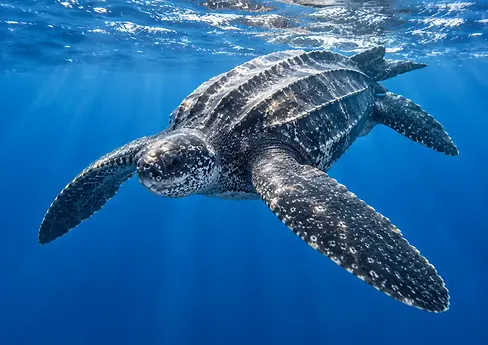
Leatherback Turtle
(Dermochelys coriacea)
The leatherback is completely different from Australia's other marine turtles.
How to recognise it
Instead of a hard shell, the leatherback has a flexible, leathery body marked by seven prominent ridges. It is dark coloured with pale spotting, has very large front flippers and is the largest of all marine turtle species.
Where it lives
Leatherbacks are adapted for long-distance travel through the open ocean, although they can also occur in coastal waters.